Comments Off on Want to be GREEN with 3D Printing? Let Terrafilum® help you be GREEN!
We collect and reuse ALL types of unbroken 3D printing spools
There are 3 ways to be green:
If you’re local, please feel free to drop them off at our facility.
If you would like to get them out of your maker space, please collect 6 or more spools, box them, note the box
dimensions and weight, then email us. We will send you a shipping label to get them to us.
If you are part of a maker community and can organize a spool drive, then let us help. Get your team and find a
location to drop off the spools. We will work with you on boxes and transportation needs.
Have more questions about the program?
Contact us:
Comments Off on Terrafilum® & Ecologic® Announce Terrafilum Ecologic ABS Filament
Terrafilum® Engineered Filaments is proud to announce its new biodegradable Terrafilum® & EcoLogic® ABS Eco-One® filament.
Terrafilum® Engineered Filaments (https://www.Terrafilum.com) is a US company that provides 3D printer filament solutions that intersect manufacturing, technology, and sustainability priorities of the 3D Printing and Additive Manufacturing Industry. The company was formed in response to its owner’s, Chris Jackson, observations of the common frustrations that manufacturers face when it comes to leveraging 3D printing technologies.
“We address 3D printing’s sustainability issue by developing industrial-grade filaments that are made of bio-friendly and re-purposed materials. We are thrilled to be partnering with Ecologic® to produce quality ABS filament with enhanced landfill biodegradation,” Jackson stated. The addition of Eco-One® in our products helps reduce overall landfill space amounts required currently for plastic products by reducing the millions of tons of plastic that would otherwise sit for years on end. The organic biodegradation of Terrafilum ABS Eco-One®filaments produces valuable biogas that landfills can recapture to convert to electricity and alleviate our demand on traditional energy sources. You can learn more at the EPA’s Landfill Methane Outreach Program (https://www.epa.gov/lmop).
Through systematic chemical and biological processes in a microbe-enriched, well-controlled landfill, Eco-One® enhances plastic biodegradation into biogas which can be converted into energy, carbon dioxide, and inert humus that enriches the soil. ASTM D5511 tests that represent biologically active landfills on Terrafilum ABS Eco-One®filaments have shown 8.11% biodegradation in the first 60 days.
Using lean principles, Terrafilum® custom engineers complete solutions — from material to spool design and always striving for zero percent waste — bringing value to their customers with material quality that assures smooth printing operations. Terrafilum®solutions are available in a wide selection of colors, sizes, and materials. Support of custom projects and applications is central to the company’s core philosophy for customer needs.
”We are very pleased to have a strong relationship with Ecologic® which is supported by other market leaders in fiber and apparel, footwear, flexible and rigid packaging, foam, sporting goods, and much more. Terrafilum® is constantly researching the development of filaments with the planet as our main concern,” Jackson commented.
The introduction of Eco-One®’s organic additive enhancing the biodegradability of Terrafilum® ABS filament without compromising on the filament’s integrity during manufacturing, storage, and use, as well as no evidence of adverse effects on printing or other post-processes, is one of the many positive aspects to the additive’s performance.Eco-One®’s addition to our products does not change the manufacturing process. Additionally, the organic additive has no effect on the plastic’s chemical or physical properties, rendering the filament with the same tensile strength and identical performance. With all these wonderful attributions to our filament, we are excited about our partnering with EcoLogic® to provide you with an industrial-grade ABS filament that aligns with Terrafilum®’s values of sustainability.
“It’s a great time for EcoLogic® as we step into the 3D Printing world! Terrafilum® is a leader in 3DP Innovation and we are excited to see what the Terrafilum® team can achieve with the Eco-One® technology. The Terrafilum® ABS Eco-One®filament represents our passion for technology & science. We hope to inspire others and spark some curiosity about how we can all make a difference,” Michael Zuppa, Business Development Engineer at Ecologic® stated.
EcoLogic® owns, manufactures, and markets the Eco-One® brand of additives for plastic products worldwide. You can learn more at www.ecologic-llc.com.
Comments Off on Terrafilum® Introduces ASA Filament to its Current Line of Products
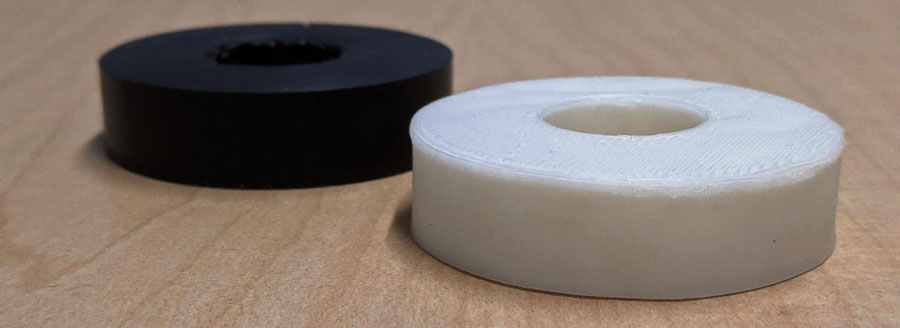
Terrafilum® Engineered Filaments is proud to announce the inclusion of ASA Filament in its line of products. The filament will currently be available in black, white, and natural colors.
To build and strengthen their 3D Filament business, Terrafilum® has added ASA resin (acrylic styrene acrylonitrile) to the filament products that they currently offer.
ASA (acrylic styrene acrylonitrile) is a thermoplastic like ABS, but with improved heat resistance and durability. ASA printed parts are strong and rigid with exceptional UV resistance, incapable of yellowing, making them exceptionally useful in exterior or industrial settings. ASA is also water-resistant, has strong chemical resistance, anti-static, and highly impact resistant. For successful ASA printing, a heated bed is needed due to its high glass transition temperature.
Terrafilum® Engineered Filaments (www.Terrafilum.com) is a US company that provides 3D printer filament solutions that intersect manufacturing, technology, and sustainability priorities of the 3D Printing and Additive Manufacturing Industry. The company was formed in response to its owner’s, Chris Jackson, observations of the common frustrations that manufacturers face when it comes to leveraging 3D printing technologies.
Using lean principles, Terrafilum® custom engineers complete solutions — from material to spool design and always striving for zero percent waste — bringing value to their customers with material quality that assures smooth printing operations. With the addition of ASA filament to what Terrafilum currently offers, we hope to continue to expand our customer base with an exceptional filament that maintains the same high standards of quality that we strive to attain.
Comments Off on Why Choose Terrafilum® Engineered Filaments
Terrafilum® Engineered Filaments is a US company providing 3D printer filaments, 3D printers, Consultative Print Services, and Specialized Coatings that meet our customers’ priorities using sustainable methods. The company’s innovative solutions are for educational and industrial professionals that demand materials whose quality and value are the best on and for planet Earth. Terrafilum® delivers products that are produced using eco-friendly materials or processes including products that are from 100% rescued, repurposed, or recycled materials. Our printer solutions are designed to work best with our sustainably produced products.
Why us?
Our products are developed and manufactured in the USA with Good Manufacturing Practices using sustainable methods. We track filament by lot numbers and have traceability to the components used
Sustainability is one of our core values. Our products are developed with materials that support environmental stewardship because we find resins that meet the 3 R’s of Sustainability – rescued resins of virgin material but have little use in the old application, repurposed virgin resins that have lot numbers but are too small of quantities for the user, and recycled resins from other production sources (including our own!)
We have strategic product development arrangements with other companies to engineer our products and create professional and industrial use 3D printing materials (i.e. XG Sciences)
We partner with our volume customers and create sustainable solutions that enable their business to recycle 100% of spools, unwanted parts, and scrap materials
Project and Product Design Capabilities for custom products, part/product concept, printing services
We offer a plethora of color options and custom colors – our current color pallet offers 27 varieties
Our filament is offered in several spool sizes with capabilities up to 20 lbs. and in 1.75mm/2.85mm
Inventory Management and Product Warehousing
Our business is family-owned and recognized as a Small Business by the Small Business Administration which means that we can respond quickly to custom needs and requests
Emphasis is placed on caring for our customer’s needs with sights on their future prosperity. We care for you, your environment, your success, and your legacy.
Comments Off on About Terrafilum Materials & Discussion
From our virtual conference in April, Jeremy Simon (3D Universe), Matt Griffin (Ultimaker), and Chris Jackson (Terrafilum) share which materials are available for use in 3D printing, how they perform, and what they are commonly used for. Learn about what makes the difference between high-quality materials that yield consistently good results and other lower-quality materials available on the market.
Comments Off on Historical Event Lesson Plans Using 3D Printing
We have always been interested in Historical Events. Chris has always been into World War II literature and the facts, battles, and people of the era. During our formative years, there was very little in the way of interactive tools to learn history. Today there’s video, interactive museum displays, and now a new method – 3D Printing!
The Library of Congress is providing a hands-on approach to learning by providing access to downloadable 3D print files from its LC Labs website. Visitors to the website can manipulate the images from various angles and see what they look like in a variety of materials, backgrounds, and lighting. The images are capable also of being measured and sliced to smaller proportions. An example of one of the accessible images is as follows, a cast of Abraham Lincoln’s hand grasping a sawed-off broomstick.
This opportunity by the Library of Congress provides a great learning tool to teachers nationwide in enhancing their lesson plans on a variety of subjects. What a great opportunity to enliven our children’s minds about historical items and events.
The Smithsonian Institution’s Digitization Program Office implemented its open-source viewer, Voyager, so that 3D models of the historical items could be displayed online.
The idea for this program was developed by library staff sensing a need for educators and school librarians to work with 3D models. Thirteen of the staff members teamed up in determining what items would be presented on the website. The research was conducted as to which audiences are interested in 3d modeling and how 3d initiatives are accomplished by other cultural environments.
Images 3D printed for educational purposes provide children not only an understanding of how it applies to their lesson plan but also in how the object is structured and have a working model for their classrooms for future students to observe. The models present an opportunity for students to pose various questions regarding the model including what it may represent, its societal impact, etc. This is a great avenue for social learning.
The Library of Congress’ contribution is just another example of the great opportunities that exist in the 3D printing world. For more information on this opportunity, take a moment to read this article at https://gcn.com/articles/2020/02/21/loc-3d-printing.aspx.
Comments Off on Polycarbonate from Biomass for Additive Manufacturing?
Finding material strength from bio produced polymers is always difficult. A team in Korea has discovered that they can produce Polycarbonate (PC) from biomass that eliminates the need for synthetic based processing. The material is thus free of potential harmful chemicals. PC is one of the toughest materials produced and professional makers love to utilize the material. When this becomes readily available, it could provide a very nice alternative to conventional PC.
Talk about a revolution for sustainable materials!
If potential uses are optical fiber as the team in Korea asserts, then a logical conclusion is that the material could find uses within FDM processes because it can be drawn into a filament. Read the more in depth article here and stay tuned for more information!
Comments Off on Does Your 3D Project Need Some Material Flexibility?
3D printers can be used to craft almost any item, but the product will fail to work as intended if the wrong material is used. If you plan on making something that needs flexibility, you should avoid using filaments that are made from polylactic acid (PLA)– the most popular kind of 3D printing material. But if PLA doesn’t work, what can you use?
Find the answer in material flexibility with a filament made with elastomers. Elastomersare polymers that have elastic properties due to their weak intermolecular bonds which allow them to stretch without breaking covalent bonds. These properties make filaments made from elastomers an excellent choice for 3D printing projects such as tires, shoe soles, insulating elements, couplings, bands, clips, and more. The most common of these elastomers are thermoplastic polyurethane (TPU), polypropylene (PP), nylon and thermoplastic elastomers (TPE).
Thermoplastic Polyurethane (TPU)
This flexible, abrasion resistant thermoplastic provides excellent layer to layer adhesion offering a durable product. Because of this, the rubber-like elasticity performs well for 3D printed sporting goods, prosthetic parts, footwear, gaskets, etc. There is some work risk, however. 3d printers are not always equipped to handle the extrusion– leading to blobs and stringing. You will need to find the “sweet spot” of temperature, printing speed, retraction and quality product materials such as Terra-Bend™.
Polypropylene (PP)
Polypropylene (PP) is one of the most frequently used and recycled flexible plastic material with usage from pharmaceutical to food-based applications. Companies choose PP because it provides low density while maintaining desired mechanical properties. Because of this, PP finds best usage in food packaging, straps, leashes, etc.
Yet, regardless of its wide-spread usage, it is one of the more difficult materials to work with. The biggest consideration is regarding printing temperatures. Due to itslow melting point and semi-crystalline structure, polypropylene cools and solidifies differently than other materials. As a result, parts have difficulty adhering to the print surface and can warp a great deal. Heated enclosures and careful selection of print temperatures can combat these issues. In order to ensure print quality, it is important to consider adhesion properties and follow printing advice from trusted manufacturers such as Terrafilum.
Nylon
Nylon has the best of both worlds by being both flexible and somewhat rigid. PA 12offers a high melting point and low friction making it perfect for functional applications such as plugs, sockets, clips, and bands. Even with all the functional benefits, working with this material offers a double-edge advantage and challenge. Nylon is very hygroscopic– absorbing moisture from both paints and from the air. This absorption rate is wonderful for aesthetics as it offers a variety of looks upon completion. Yet, the moisture from the air can be a problem prior to completion. For best results, it is recommended to dry the material prior to printing, and vacuum package between prints if possible.
Thermoplastic Elastomer (TPE)
Thermoplastic Elastomers (TPE)are the most popular choice for 3D printing projects needing material flexibility. When used correctly, products made with TPE material can stretch up to double their length then easily return to its original shape due to its rubber-like quality. This quality makes TPE appropriate for anything that needsimpact or vibration resistancesuch as gaskets, couplings, connectors, etc. But be sure to be on the lookout for buckling and plate adhesion as printing too fast with this flexible filament can cause these issues.
Regardless of what material flexibility you need, there are a multitude of aspects to consider. Therefore, it is important to do your research before buying and make sure you are matching the right filament material to the right application. This match will ensure a perfect print every time.
Comments Off on 50 Fastest Growing Companies Of The Year 2019
“We are thought leaders in sustainability practices and custom materials selection.”
3-D printing is an unstoppable force. Not too long ago, the printing speed and limited output of 3-D printers made them suitable only for rapid prototyping. But in the coming years, 3-D printers will be at the heart of full-scale production capabilities in several industries, from aerospace to automotive to health care to fashion.
In light of the former, we’re thrilled to present Terrafilum®.
The company provides 3D printer users with the highest-quality, eco-friendly filament solutions on the market for all of their printing needs.
Terrafilum® was incorporated in 2017 and is headquartered in Cary, Illinois.
Chris Jackson, Terrafilum® President, spoke exclusively to The Silicon Review.
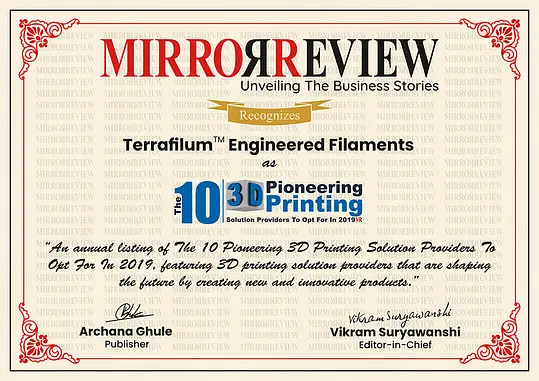
Comments Off on The 10 Pioneering 3D Printing Solution Providers To Opt For In 2019
The future of manufacturing has arrived bringing waste reduction, complex customization, and fast prototyping in the process. It is 3D Printing or one can call it as “Additive Manufacturing” which has come a long way from being a theoretical concept to reality. As you are reading this, 3D printers are creating new products and consequently, shaping our future. They have proved their essentiality in many industries including aviation, education and, most importantly, healthcare.
We, the team of Mirror Review, are really excited to introduce our latest magazine issue, “The 10 Pioneering 3D Printing Solution Providers To Opt For In 2019”, featuring Terrafilum™ Engineered Filaments as the Cover Story. Terrafilum™ is satisfying clients’ 3D printing needs with one of the highest quality eco-friendly filament solutions. Born out of a passion for Business, Manufacturing, and Golf, Chris Jackson, the Founder of Terrafilum™ formulated the 3D printing concept with his prior 30+ years of experience and hard life lessons.
In addition to the inspiring story of Chris and Terrafilum, I feel privileged to present interesting journeys of leading 3D printing solution providers which are uplifting the manufacturing capabilities to an advanced level.